

Vela Luka

Vela luka is situated on the island of Korcula which belongs to the group of middle Dalmatian islands. Island has a surface area of 276 km2 and it is the sixth biggest island in the Adriatic. The island is divided from the peninsula Peljesac by a narrow channel and it was of great importance to the maritime powers.
Because of its importance, its masters changed often: the Hellens, the Romans, the Venetians, the British, the Russians and the Italians.
Korcula is one of the most wooded islands on the Adriatic. It is a typical Mediterranean area with various sorts of flora: cypress, alepian pine, pinia, olive, oak, myrtle. Indigenous herbs and aromatic plants also grow on the island: sage, rosemary, lavender, immortelle, mint, marjoram etc. The Roman version of the name Korcula was CORCYRA NIGRA, the Hellenic version was CORCYRA MELAINA, both names bear reference to the dense pine-woods of the island.
How to get to Vela Luka:
Ferries From Split to Vela Luka:
- Ferry timetable for catamaran saling from Split to Vela Luka (Korcula) – Lastovo : This ferry sails at least once a day (depending of the season). This is foot passenger only ferry service from Split to Vela Luka
- Ferry Split – Vela Luka (Island of Korcula) – Timetable : Twice a day ferry service from Split to Vela Luka, includes foot passengers and cars.
From Dubrovnik to Vela Luka:
- New:Dubrovnik Airport to Vela Luka bus shuttle
- Daily bus service from Dubrovnik to Vela Luka via Korcula Town – check info and timetable
- Detailed bus schedules
From Pescara to Vela Luka:
- Weekly ferry service from Pescara (Italy) to Vela Luka (also see Vela Luka to Pescara ferries) – this fast ferry is sailing in the high season only – July and August. It takes just over 4 hours to reach Vela Luka from Italy. A very good service 🙂
From Proizd to Vela Luka:
- daily seasonal foot passenger ferry service between Proizd and Vela Luka – all details here
Hotels in Vela Luka
Vela Luka hotel reservations – Book a hotel in Vela Luka online and save money. Best price guaranteed! In partnership with Booking.com
- Hotel Korkyra , Vela Luka, Korcula
Hotel Korkyra was renovated in 2010 and it is situated in the centre of Vela Luka on the island of Korcula. The elegantly designed rooms feature air conditioning and balconies. You can relax at the outdoor pool in the green inner courtyard and be pampered in the wellness area of the Korkyra. Hotel Rooms: 58. Prices from Euro41
Check Hotel Korkyra, Vela Luka, availability - Browse and book hotels in Vela Luka
- Listing of Vela Luka Hotels
Some photos of Vela Luka:
-

- Vela Luka – Ferry Arrival

-
- Vela Luka in 1902

-
- Vela Luka in 1910s

-
- Wine Traders @ Vela Luka in 1900s

-
- Vela Luka in 1923

-
- Vela Luka in 1924

-
- Vela Luka in 1920s

-
- Vela Luka in 1939

-
- Vela Luka in 1959
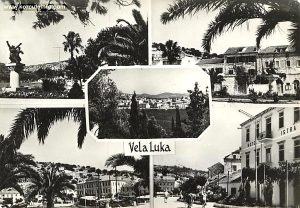
-
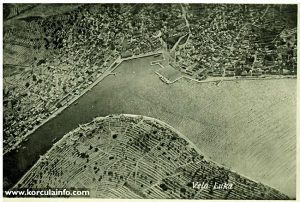
- Birdsview of Vela Luka bay (1920s)
Latest news from Vela Luka:
– link to all posts tagged “vela luka”
About Vela Luka:
Corcyra- the oldest name was given to the island by the founders of the main settlement on it, people from the Hellenic town of Knidos. As the same name was used for Corfu in Greece, Strabon (1st century B.C.) added the adjective “melania”-“black” to differentiate it from the Corcyra in the South. The Venetians influenced the change of the title and the island was named “Curzola”. The present name for the island of Korcula derives from it.
Vela Luka is positioned on 42 N and 16 E on the western side of the island, 45 km from the town of Korcula, and it is the largest town on the island, a municipality with almost 4.500 inhabitants.
The town developed at the beginning of the 19th century in a deep sheltered bay with tranquil inlets and tiny islets.The major part of the town spreads over the slopes of Pinski rat (150m) and the mildly descending plateau between the Rat and Humic elevation(183m). The surrounding hills protect it from the northerly and southerly winds. The climate is typical Mediterranean. The highest temperature in January is between 7,9 and 9,1 C, and in July between 24,9 and 25,6 C. Although Hvar is often called “The Adriatic Madeira”, Korcula has a higher mean temperature in January (9,1 C), even higher than Dubrovnik (8,7 C), while Hvar has 8,6 C, Nice 8,0 C, Naples 8,2 C etc. The number of sunshine hours yearly is quite big. Vela Luka, for example, has 2.671 sunshine hours, which is the highest figure for whole of the Adriatic.
In the last century Vela Luka has emerged from a fishermen’s and peasant’s village to an attractive, cultivated and picturesque small town. Chief occupations are farming, wine production, olive growing and processing, shipbuilding and of course tourism.
The life and culture of the Mediterranean region can be traced in exceptional archeological finds from Vela spilja (Big cave), situated above the town at the North-East side 100 meters above sea level in the region of Pinski rat. The Croatian Academy for Sciences and Arts has been excavating here since 1974. A great quantity of valuable archeological material has been found as: ceramics, stones, flints, bones, confirming the value of this locality not only for establishing prehistoric traces on the island of Korcula and middle Dalmatian island but also on the whole coast of the East Adriatic. This archeological material is kept in the museum collection in Vela Luka.
Among the monuments worth mentioning are: parish church of St. Joseph which is a classical building finished in 1848. and the bell tower from 1871., the chapel of St. Vicence, from the year 1589, was reconstructed several times and contains the bust sculpture of Don Ivan Oreb, a priest who did a lot for the cultural development of Vela Luka in the 20th century.
The leading tourism company in Vela Luka is HUM HT d.d. Hotel organization of HUM has 760 beds at its disposal in hotels: Adria, Posejdon, Dalmacija and Jadran.It has also launches and mini bus for the transfer of tourists to the excursion points.
Hotel Adria is situated in a tranquil bay of Plitvine, among olive groves, 2,5 km from the centre of Vela Luka. Because of its extraordinary micro climate,warm sea, great number of sun hours per year, Mediterranean vegetation and especially location, Adria has the most unique position and conditions in the region.
Hotel Adria has 119 double rooms and eight family rooms and all the facilities necessary to make Adria attractive resort all the year round.At the hotel guests disposal is the recreational-medicinal tract with sauna, gym, massage room and indoor swimming pool with warm sea water.
The tourists also have at their disposal a wide range of different excursions. Very popular are so-called “fish-picnics” and night cruises by ship trough bay, accompanied by romantic music. The pretty little islands Osjak and Proizd with their Robinson silence, crystal clear sea, flat cliffs and white beaches are a real paradise for bathers. Other excursions are organized mostly by bus to Dubrovnik, Medugorje and a cruise of the island itself including the town of Korcula. Also it is possible to participate in sea fishing and net casting activities and in the autumn months in olive picking.
More info about Vela Luka:
- Korcula Travel Forum
- About Korcula
- Getting around
- Beaches
- Sights
- Restaurants
- Excursions
- Activities
- Nightlife
- Places on the Island
- Weather
- Visual Korcula
- Photos
- Getting Here
- Flights and Airports
- Ferries Korcula
- Buses & Roads
- Maps of Korcula
- History and Culture
- Art
- Architecture Korcula
- Museums
- History
- Marco Polo
- Moreska
- Sport Activities
- Cycling
- Fishing
- Sailing
- Walking Korcula
- Windsurfing Korcula
- Accommodations
- Hotels
- Apartments & Rooms
- Camping
- Other Info Korcula
- Korcula Blog
- Dubrovnik
- About
- Privacy Policy
- Contact


